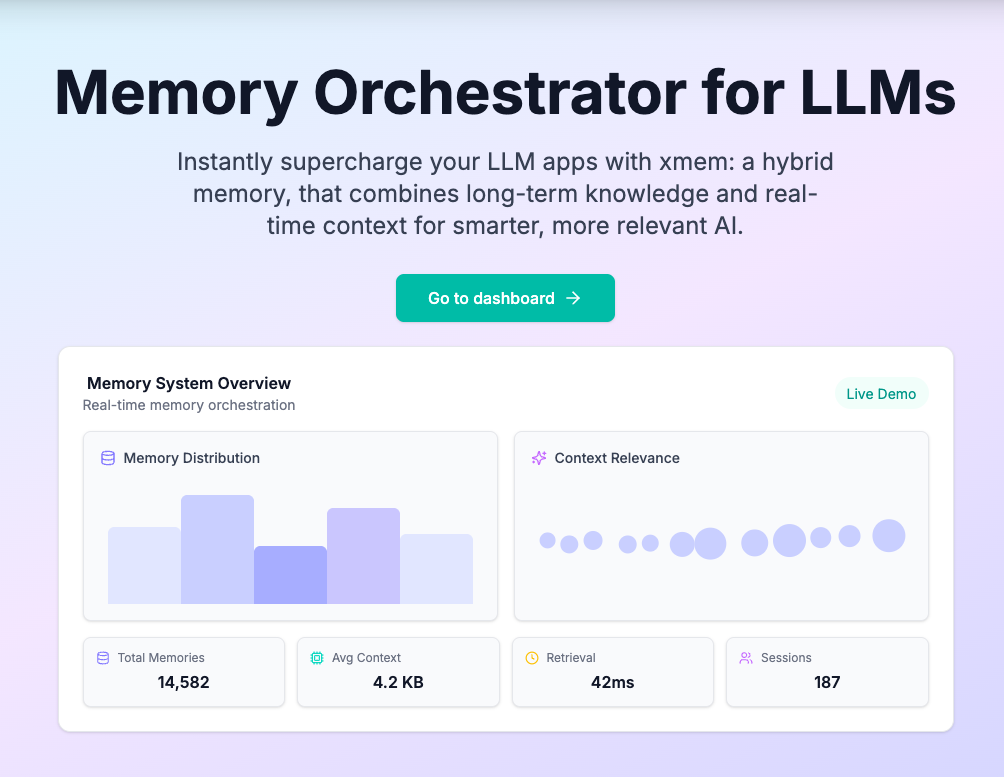
Hybrid memory for LLMs: long-term, session, and context management to make AI always relevant and accurate.
xMem is a hybrid memory orchestration platform for LLMs that combines long-term knowledge, session memory, and real-time context to make AI responses smarter and more relevant. It provides persistent memory for every user, ensuring that LLMs never lose context between sessions. Features include vector search for long-term memory, session tracking, RAG orchestration, and a knowledge graph for dynamic context linking. It integrates with open-source LLMs and vector databases, and offers an easy API and dashboard for monitoring.
Key Features
check_circleLong-term memory with vector search
check_circleSession memory tracking
check_circleRAG orchestration
check_circleKnowledge graph visualization
check_circleReal-time context assembly
check_circleOpen-source LLM support
check_circleVector DB integration (Qdrant, ChromaDB, Pinecone)
check_circleEasy API and dashboard
check_circlePersistent memory per user
check_circleLow latency retrieval
Use Cases
lightbulbCustomer support teams use xMem to retain user conversation history, so returning customers never have to repeat themselves and agents get full context instantly.
lightbulbAI chatbot developers integrate xMem to provide persistent memory across sessions, enabling personalized responses that reference past interactions and stored knowledge.
lightbulbKnowledge management professionals leverage xMem's vector search and knowledge graph to link documents and concepts, making internal knowledge bases more accessible and context-aware.
lightbulbRAG pipeline engineers use xMem to automatically assemble the best context from long-term and session memory for each LLM call, improving answer accuracy without manual tuning.
lightbulbAI copilot creators embed xMem to maintain project and team context across multiple conversations, ensuring the AI always knows the current state and history.
lightbulbOpen-source LLM users deploy xMem with Llama or Mistral to add memory capabilities, enabling their models to recall past discussions and user preferences for more coherent interactions.